Florida homeowners in golf course communities spent this spring watching a bill move through Tallahassee that could let a developer replace an idle fairway with rooftops in about a year, with only staff-level sign-off and no public hearing required. The Infill Redevelopment Act cleared the state Senate without a single no vote and sailed through the House before landing on the governor's desk, and it has golf-adjacent owners across Florida wondering whether the view they paid a premium for is as permanent as they assumed.
At Old Marsh Golf Club in Palm Beach Gardens, that anxiety points at the wrong target. Most of the open land buffering Old Marsh homes was never classified as a golf course to begin with. It was built, acre for acre, to satisfy a wetland mitigation requirement from 1986, and that distinction matters more to a 2026 buyer than anything printed in a club brochure.
A Law Built for a Different Kind of Course
The new law targets recreational sites in a specific, narrow way. A developer has to prove the site sat idle for at least 12 consecutive months, pay double the standard parks and recreation impact fees, and notify every adjacent property owner by certified mail. Those neighbors then get a 90-day window to buy the land themselves at a price capped by statute before the developer can move forward. It's a real mechanism, and HousingWire reported that critics expect it to generate insurance disputes and zoning challenges for years. The Real Deal covered the same bill as part of a broader pattern of the state stripping local governments of zoning authority in the name of housing supply.
Here's the part that gets lost in the coverage: the law applies to golf courses, tennis courts, and clubhouses sitting idle. It does not touch land that's been separately designated as regulated wetland. Those are different legal categories, and at Old Marsh they cover different ground.
What Pete Dye Actually Built
In 1986, developer Bob Whitley hired golf architect Pete Dye to design a course on a 440-acre parcel enclosed within roughly 40,000 acres then owned by the MacArthur Foundation. Dye later wrote about the project for Florida Golf Magazine, describing wetland setbacks that took years to get authorized before construction could even begin. Under the mitigation rules that applied, converting one acre of marsh required creating three acres of new marsh elsewhere on the property. Dye's own account puts the conversion at roughly 10 acres, which meant engineering nearly 30 acres of new, contoured wetland within Old Marsh's boundaries before a single fairway could be finished.
That engineered marsh wasn't landscaping. Dye described building shelves of varying depth to support specific aquatic grasses, and a six-foot moat along the marsh edge designed so golf balls would roll uphill and out rather than sinking into the habitat. The course was certified as an Audubon Cooperative Sanctuary in 1998, a voluntary program layered on top of the original permit conditions, not a substitute for them. As Dye put it in that same essay, "Old Marsh couldn't be more ideal or special."
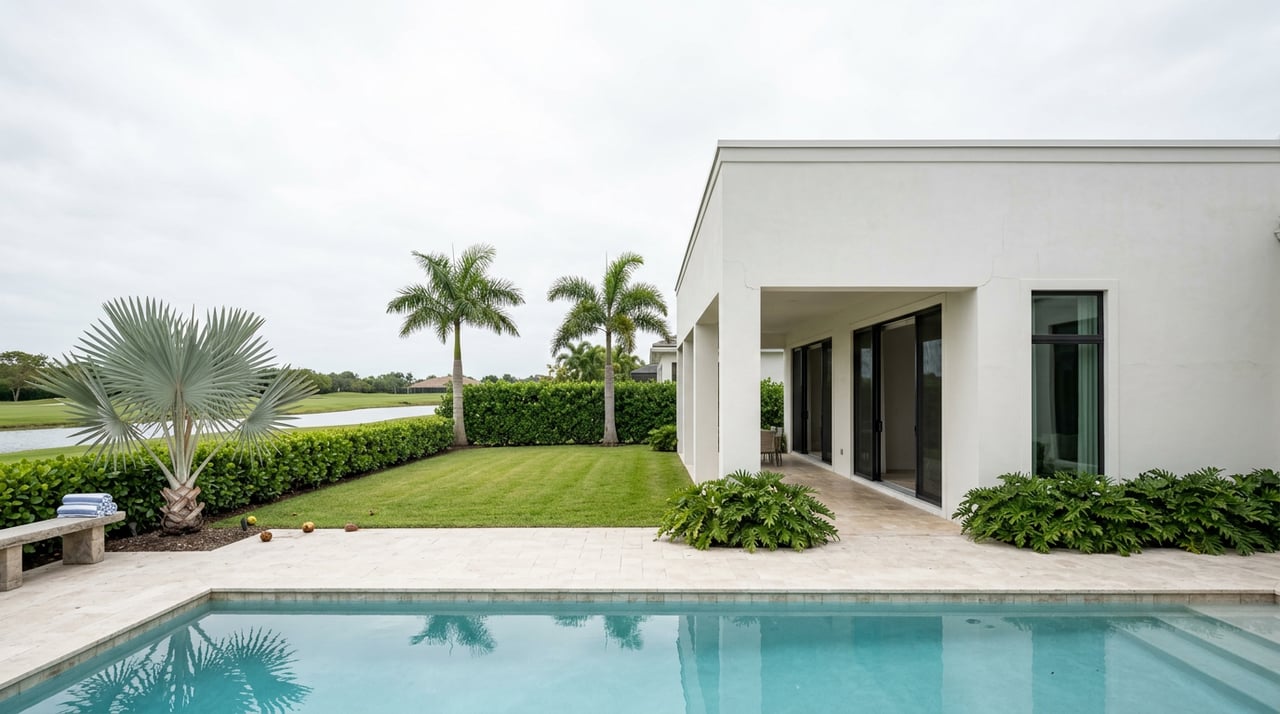
Twenty percent of the community's 456 acres is marshland, and untouchable wetland edges the property on three sides. The course itself has been touched twice since: a 2004 update to keep pace with modern equipment, and a more thorough 2016 rebuild led by Dye collaborator Chris Lutzke to restore the layout to its original design. Neither project altered the marsh boundary, because that boundary was never the club's to alter. It was a condition of the original development permit.
Numbers Even the Club's Own Paperwork Disagrees On
Buyers evaluating Old Marsh quickly run into a second, smaller version of the same lesson: even the most basic facts about the community depend on which document you're reading.
| Source | Homesites reported | Membership figure |
|---|---|---|
| Old Marsh Golf Club's own real estate page | 180 | Not stated |
| Old Marsh's 2023 dues and fees schedule | 180 | 275 equity members |
| Old Marsh's membership page | Not stated | "Strictly limited to less than 300" |
| Frankel Ball Realty's community page | 172 | Not stated |
| Echo Fine Properties' community page | 186 | Not stated |
None of these sources contradict each other maliciously. They likely reflect different counting methods, different points in time, or the gap between platted lots and built homes. But it's worth knowing, before you assume a listing's stated homesite count is gospel, that the club's own materials don't fully agree with each other either. The same goes for cost. Initiation fees at Old Marsh are widely estimated in the $140,000 range with annual dues near $13,850, but the club does not publicly release its fee schedule, so treat any specific figure you see, including that one, as an estimate to confirm directly.
What the 2026 Sales Numbers Actually Say
The price data tells a similar story about a market too thin to produce a stable number. Over the three months ending in July 2026, one widely used tracker put the Old Marsh median sale price at $3.8 million, down 5.6 percent from the same period a year earlier. A separate tracker, as of May 2026, showed a median of $4.95 million with an average sale price above $5.1 million. Other 12-month readings on the same community have shown the median moving in opposite directions depending on the exact window measured, in one case up more than 20 percent year over year and in another down modestly.
That kind of spread doesn't happen in a market with real volume. It happens when a community with somewhere between 172 and 186 homes produces roughly ten transactions in a given year. A single $45 million estate listing or a single $3 million renovated cottage closing in the same quarter can swing a median by six figures without reflecting any actual shift in what Old Marsh is worth. Days on market tell the same story from a different angle, with figures ranging from the mid-70s to well over 100 depending on the source and the window, all of them longer than the national average, which is normal for a market this small and this selective.
If you're comparing Old Marsh against a larger golf community with 50 or 100 annual sales, remember you're comparing a statistically noisy number to a statistically stable one. The noise isn't a red flag. It's what a genuinely low-turnover, invitation-only market looks like from the outside.
What to Ask Before You Assume the View Is Permanent
Whether you're evaluating Old Marsh specifically or any golf-adjacent property in Palm Beach Gardens this year, a few questions are worth raising before you write an offer, ideally with a real estate attorney who can confirm the answers against recorded documents rather than relying on marketing language:
- Is the buffer land behind this lot part of the golf course lease, or is it separately deeded as regulated wetland or conservation area?
- If it's wetland mitigation, when was the permit issued, and does the recorded easement run with the land in perpetuity?
- Has the club or course ownership changed hands recently, and if so, does the new owner have obligations tied to the original mitigation permit?
- How many transactions has this specific community seen in the trailing 12 months, and does that volume support the median price being quoted to you?
None of this is legal advice, and the answers live in county records and recorded easements, not in a listing description. But asking the question at all puts you ahead of a lot of buyers who assume every green space behind a Florida golf home carries the same protection.
A Short FAQ
Does buying a home in Old Marsh require club membership? Membership at Old Marsh is by invitation and the club caps equity membership, with club materials citing figures from 275 to just under 300 depending on the document. Some listings note mandatory membership applications, so confirm the current requirement on any specific property before you write an offer.
Could the golf course itself ever be redeveloped under the new law? Theoretically a golf course anywhere in Florida could qualify if it sat idle for 12 months, but that scenario has nothing to do with the wetland acreage discussed here, which was created under separate permit conditions and isn't part of the course's recreational footprint in the same legal sense.
Why do sale price estimates for Old Marsh vary so much between sources? Old Marsh sees roughly ten transactions a year across a homesite count that itself varies by source. That volume is small enough that a single high or low sale can move a reported median significantly, which is why any single stat should be checked against the underlying transaction count, not taken at face value.
If you're weighing Old Marsh against another private club community in Palm Beach Gardens, or trying to make sense of what a listing's numbers actually mean before you commit to a showing, Brad and Shannon Ball can walk through the recorded documents, the club's current standing, and the real transaction history behind any property you're considering.